|
Practice |
  
|
|
Practice |
|
As any user of digital imaging tools will discover rather quickly, over-processing of digital images is an easy yet equally tempting task.
Keep it Real
Keeping images look real is a much harder task that require professional discipline to resist the temptation of going too far with the sliders. The professional rule of thumb is that the processing should not draw the attention away from the subject, rather compliment it.
Yet browsing various photography sites it is obvious that the over-processing trend is often used without much reason for it: for example over-processed clouds will draw more attention than the main subject, the subject can be completely lost within the excessively pronounced surrounding textures or there is no main subject at all - it is just a shot of nothing in particular with a faint hope that over-processing will make it better.
If your goal is a photography, you have to look at the image and be your own critic:
| • | Does the image tells a story? |
| • | Does it generate a special feeling or curiosity in the viewer? |
| • | Does the image stand on it own even without any processing? |
| • | Is it a shot worth exploring further? |
A major mistake is to take shot that doesn't pass any of the above criteria - being just a snapshot of nothing in particular - and then try to apply the HDR techniques hoping it would magically make the shot better.
The news on the street is that it will most likely make it even more painful for the viewer.
In music there is a great distinction between a good song or a bad song played much louder.
Make it an art
Processing images with HDR tool-set without regard for realism but with goal of exploring a texture could be viewed as a modern form of impressionistic painting. Impressionist tries to evoke a special feeling in the audience not by the subject of its art but by the art itself and the method he is presenting it. And yes, they got smeared and laughed at by the traditionalist painters either.
A good example of this could be a Starry Night by Vincent VanGogh where the texture itself become the main subject of the image and it is irrelevant that it presents a night sky above some village in a completely surrealistic form. You can actually hang the painting upside down and it will still make impact.
However as with the Realistic photography, the impressionistic art doesn't involve taking a random picture and then applying a bag full of digital tools in hope something will stick to it. This would be the same as accusing Vincent VanGogh of trying to paint a realistic but uninteresting scene of a night village and then trying to save it by using excessive technique.
The art actually comes with far more planning than the real photography. With a real photography we have set of many rules (3 point lighting, shallow DOF, rule of thirds etc..) which if carefully followed could result in a good professional image. A portrait studio makes a good portraits by following rules not by trying to produce art.
With art, there are no rules.
What areas to avoid
We presented two sides of the application for HDR technique - realistic photography and art. You may try to fit your results in-between but word of advice: this is actually much harder to do than to produce good results on either side of it.
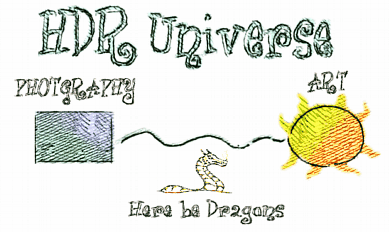
There are very few photographers that succeeded in producing photography that is both impressionistic and realistic at the same time.
One commercial photographer comes to mind as a good example: Dave Hill. (www.davehillphoto.com) whose images are often compositions of various well planned, prepared and professionally executed shots.
Unfortunately it seems far too many people are trying to succeed in this in-between area neither making good photography, nor making a good art and then (rightfully) receiving unfavorable critique.
Our suggestion is to focus on either side, plan your shots carefully and try to master it as best as you can. Then try it the other way. When you succeed in both art and photography you may venture in the scenes in-between.