


Are you gnarly enough?
It started, as these things always do, with me cutting something in half. In this case, a hard drive enclosure, in my attempt to use SSDs as
oversized SD cards. You know, an ordinary day. Then I needed to 3D print a piece for the opening, which got me thinking about fancy
textures in 3D printed objects and why we don’t have them.
Texturing objects for 3D printing isn’t something most slicers generally do beyond fuzzy skin, and there’s a good reason for that.
Displacing a mesh to create texture can also create a remarkable amount of unprintable garbage.
I’d previously toyed with Blender for remeshing and texturing STL files, with about fifty percent success. The
other fifty percent was spent fixing the problems it created. Blender has no particular interest in your slicer or
the hundreds of little rules that determine whether an object will actually print.
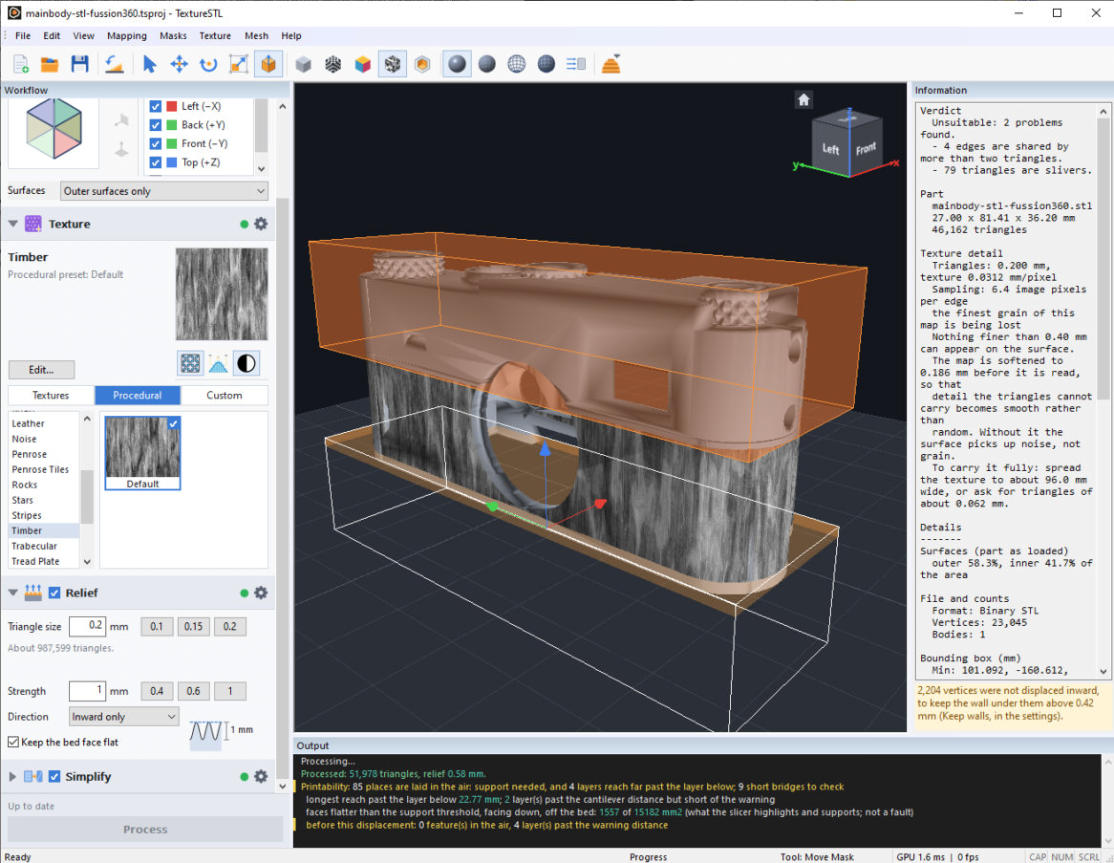
So Gnarl3D was born: an app dedicated to adding texture relief to 3D objects, with an understanding of what
makes them printable.
The breakthrough came when I finally abandoned mesh displacement (the ugly way of thinking in triangles)
and rewrote the whole thing around solid body displacement, an approach that closely mimics the 3D printing
process and avoids many errors of mesh displacement (like crossing triangles and non-manifold edges)
Why Gnarl?


CRANKY MAN LOVES 3D PRINTING
Add Texture to 3D Printed objects
There are plenty of ways to displace a mesh with a texture. I tried them all. Then I spent more time fixing the result than adding the texture.
Gnarl3D follows a single rule: the object is not just any mesh, it is 3D printable. This shapes the entire process, from the start to the finish.
•
Real geometry using solid object displacement with mapping (depth map or procedural textures)
•
The bed is protected: the bottom stays flat and the part sits on the plate.
•
No self-crossing surfaces, no crumbs (typical for mesh displacement)
•
Simplifying large meshes
•
Repair for broken input meshes
•
(PRO) Texture only where you want it: Volumetric Masking , Outer/inner surfaces
Windows 10, 11


Free, functional no-strings-attached version
•
Most of the functionality is there
•
Cubic and planar mapping supported
•
Basic directional projection masking
•
You don’t have to give Cranky Man a dime
Get the gnarly full featured cranky version
•
Adds Cylindrical and spherical mapping
•
Automatic Outer and Inner surface masking
•
Volumetric Masking
•
One time payment - yours forever, free updates




Gnarly FAQ
How is this different from fuzzy skin?
Fuzzy skin is your slicer randomly wobbling the wall as it prints. It’s a trick, but it works. Gnarl3D changes the model itself, so you choose
the pattern, where it goes and how deep it is. It also works on top surfaces, where fuzzy skin can't go at all.
Does it work with my printer or slicer?
The input is a STL and the output is a STL, so any slicer should be fine with it: Bambu Studio, OrcaSlicer, PrusaSlicer, Cura.
Any suggestions for best practice?
Remember what Gnarl3D does: it adds polygons where the texture needs them. More polygons can describe finer detail, but your printer
still has to print it. On a typical FDM printer, think roughly 0.2 mm, give or take depending on your nozzle, settings, and print orientation.
Because FDM builds objects in layers, textures generally look better on the sides than on the top. Give them some room, too. You can
surely add 0.2 mm detail into a 5 mm screw head, but you’ll get a tiny potato blob. Large, flat surfaces like boxes and rectangular parts
work well, as do vases and other cylinders using cylindrical mapping.
Physical size matters. A larger object needs more polygons to reproduce the same level of detail, so you may end up with millions of
triangles. Slicers can usually handle that, but slicing will take longer. It’s a price to pay, I guess.
Be careful with mechanical parts that need a precise fit. Remeshing can alter their geometry enough that parts no longer fit together. The
Pro version lets you texture only the outside while keeping the inside surfaces flat. This is a sensible choice when the inside needs to fit
something.
Mac or Linux?
Windows 10, 11 only for now :) It’s Cranky Man’s fault.
Can I keep texture off certain areas?
Yes, this is where PRO shines. Mask volumes keep texture off any area you mark. Inside surfaces can
stay smooth automatically, and the bottom always stays flat on the bed.
Can I sell prints I make with it?
What? Now that’s a silly question. Of course.
Do updates cost extra?
No. Cranky Man is not that greedy. All the future updates will be free for previous paid users.
Can I use it for something else?
Incidentally during the development a SOTA Isometric Remeshing was created which is slow (a minute or so) but it produces very accurate
results (far better than other remeshing like the more typical Dualcon). Is not actually used anymore - as then Gnarl Switched to Solid
object displacement, but it is still there. So you can load a STL, then go to Mesh - Remesh Input Mesh, then save it.
Free - like really free.
$25




Get Manual.pdf (also installed with the installation)



